Bust · Psychology · Science · thoughts

Blindspot: Hidden Biases of Good People Borrow by Mahzarin R. Banaji

Blindspot ended up in my Kindle cue after I took a course in “unconscious bias” at work.  The course was incredibly interesting and through a few exercises, I discovered that I one of my unconscious biases was “Tall people have bad balance”.  Looking back, I have no idea why I think/thought tall people had bad balance, but it was something applied to every tall person encountered, regardless of whether or not I’d seen them demonstrate poor balance.

Digging deeper, I’m sure we all have biases we can’t explain and Blindspot promised to be a good excavation tool into understanding the hows and whys of those unconscious biases.  Based on the expectation that this book would provide the psychology or explanation behind bias, the true content of Blindspot ended up as a bit of a surprise.

First off, it read more like a long article than a book, with the purpose of each chapter to explain the experiments and results the authors achieved when testing subjects for various unconscious biases.

Secondly, I was very wary of what felt like finite conclusions reached by the authors that they were bias this way or that way, or that subjects maintained particular biases when the later chapters demonstrated that positive exposure prior to the experiments significantly impacted the results of the bias.

Leading into this, it was incredibly unsettling to read elsewhere that some employers were actually using experiments similar to those in Blindspot to vet potential employees for hire-ability.  For one thing, the experiments only measured a preference or an association of X against Y, without any way to account for “real life conditions” like previous experience, context, location, morals, upbringing, and personal values.

If anything, Blindspot was eye-opening in just how much previous experience can alter the bias, leading me to conclude that while we all have biases, they can change over time and experience.  It was also interesting to note that we didn’t have to actually be being attention to the experience of something (like a commercial or magazine ad) for it to imprint in our brains.  This led to an internet rabbit hole of research down the path of marketing tactics and how they are used to influence us to feel and buy.  While I wasn’t overly bowled over by Blindspot, kudos to them for providing a pathway into interesting conversation topics on social engineering.

Until next time, happy reading friends!

-R

Book Review · Gonna Need a Stiff Drink For This One · Historical Fiction · tear jerker · thoughts

Before We Were Yours by Lisa Wingate

51P7QgQ0DjL._SX326_BO1,204,203,200_Y’all…I did it again.  Went to bed w/ a new book at 8:30pm fully anticipating an hour, maybe hour and a half of reading and a reasonable bed time….and ended up reading until 1am.  Sigh…I’m so energetically sleepy it’s weird.  This must be how toddlers feel when their eyes are half closed but their body is happy dancing at top speed.  While delicious, this Green Tea is doing nothing for me.

So, during a book chat last week, a friend linked me to the Amazon Top 20 Chart last week, where I scrolled through the list looking for some new reading material.  I was surprised to find 7 Harry Potter books on the list along with the The Handmaid’s Tale.  It’s interesting to see so much Harry Potter on the list.  I remember seeing the first few books lined up together for the very first time on the library shelf like 15 or 20 years ago and thinking “holy shit, those things are HUGE”.  It’s such a strong memory, that to this day I can tell you the exact shelf and location of those books.  Weird memories aside, it’s amazing they’ve remained so popular and have really become such a normal part of the cultural sphere.  Ready Player One was also an unexpected find, but all of the movie hype has probably got this one ranking high in the charts in anticipation. Like The Martian, Ready Player One has only one real main character in the entire book.  I’m interested to see how that translates into a movie.

Having read 9 of the 20 books on this list, I started combing the library for the other 11.  Origins by Dan Brown had an 86 person wait list (what-the-what?!?!) but “Before We Were Yours” was available.  This book has been on the Amazon Top 20 for 25 weeks now, and after getting so caught up in the web Wingate has weaved, it’s easy to see why.

“Before We Were Yours” is a historical fiction based on the notorious Georgia Tann of the Tennesee Children’s Home Society.  From 1920-1950, Tann lied, schemed, plotted, and outright kidnapped the babies and children of America’s poor working class, often taking advantage of young single mothers as she procured children for her black-market baby adoption agency.  Most alarmingly, Tann had the support and cooperation of Memphis government officials, who not only knew but enabled her heinous crimes against families and children to continue for decades.

The book is written in a multiple person format, which did take some getting used to at first, particularly as the switch between characters could be jarring at times between chapters.  Interestingly enough, the story as told by Avery Stafford is stylistically written very differently than the story as told by Rill Foss and May Crandall .  It’s almost like reading two different books.  So far, I have preferred the voice and narration of Rill and May.  These characters feel very real and very grounded to me, like the author based them on someone she knew well.  The story swells and builds around Rill and May, until your heart clenches and you’re holding your breath with each page turn.

Avery, on the other hand, comes across with every stereotypical rich white-girl cliche the author could come up with.  She’s from a wealthy Southern family whose roots run deep into the political sphere.  She went to Colombia law school where she worked hard to distinguish herself from her own last name and is now a federal prosector.  The lawyer thing comes up frequently in Avery’s self monologues, like she’s reminding us over and over that she is smart and capable.  She grew up owning/riding horses and spending time with Grandma at the family beach house.    Her Daddy is an upstanding honorable man who just so happens to be a US Senator while her mother is the stereotypical overbearing Southern Belle of a Stepford wife whose organizational prowess, social standing and charity work are a force to be reckoned with.  While big things loom around her, Avery’s biggest concerns in life are missing her fiancee’s calls and dodging conversations about her wedding plans.

I’m about 75% done with the book and have been reading through Avery’s narration in anticipation of Rill’s and May’s chapters.  Looking forward to what the conclusion brings!

Happy reading,

Cheers!


Book Review · Books to Movies · children's books · Favorite Books · horchata · thoughts

Ferdinand!  Book to Movie review

ferdinand the bull book coverYou guys! So you remember how excited I was to find out Ferdinand was being made into a movie?  Well, the Little Man and I had a date to see Ferdinand last week and after a false start with a sold-out showing and calming down a pissed off child with an ice-skating adventure, we finally got to see my childhood fav up on the big screen.

Whenever a favorite book gets turned into a movie, there’s a huge chance the director will take beloved characters and plotlines and turn them on their head (HP, Twilight, I’m talking to you).  There’s also the chance the director will take the book and magically transform everything in your imagination directly onto the big screen.  Wimpy Elijah Wood as Frodo aside, Lord of the Rings was fantastic for this.  While it’s easy to see how they can turn chapter and series books into movies, it’s a bit harder to see how a director will stay true to a story from a children’s book that’s less than 20 pages, so I was very interested to see what they’d do with Ferdinand.

Let’s start this book-to-movie review with John Cena.  Despite his tough guy appeal, wrestling fame and action flicks, John Cena has always come across as the love-able meat-head, just like Ferdinand.  Celebrity crushes aside, he was absolutely, hands down, the BEST choice to voice Ferdinand.

Like the book, Ferdinand-the-movie, was based in Spain, told the tale of a gentle, flower-loving bull, involved a bee and a bull ring.  And that’s about where the similarities end.  Ferdinand-the-book is a sparse gentle tale that allows the reader to infer and imagine many things about Ferdinand, his mother, his home and his life.  So much so, that the book became controversial in its interpretations.

Ferdinand-the-movie, on the other hand, is a coming of age tale whose message of self-acceptance cannot be disputed or misinterpreted.  The movie places Ferdinand, the gentle flower loving calf, smack dab in the middle of a bull fighting farm with his father, where he is surrounded by bulls and calves determined to fight their way into the bullring.  Like the book-Ferdinand, the movie-Ferdinand is a misfit who prefers flowers to fighting, earning him the ire of the other baby bulls.

From here, the film races forward with action and adventure not found in the book, with Ferdinand eventually finding himself squaring off with El Primero, the number one matador in Spain.  Despite all of the deviations from the original tale and the addition of a weird annoying sidekick, for me, seeing Ferdinand staring into the eyes of El Primero is where Ferdinand-the-movie shows a true understanding of the character Munro Leaf created.

While I won’t be re-watching Ferdinand endlessly until the DVD just gives up like I did with Spirit: Stallion of the Cimarron, Ferdinand-the-movie was a fun afternoon adventure with my kid.  I’d def recommend it if your family, like ours, enjoys reading books and watching the movies based on those books.

Until next time, happy reading!

Cheers,

-R

Book Review · Bust · spoilers · thoughts

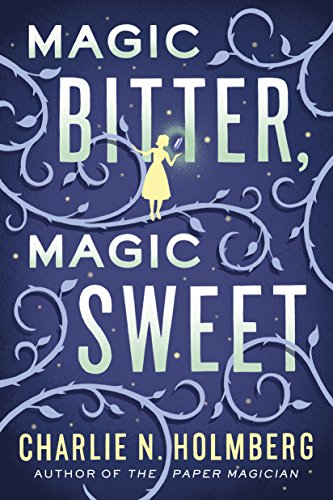
Magic Bitter, Magic Sweet


51odUtgGCTLAfter reading The Mermaid’s Sister and Son-of-Gold by Carrie Anne Noble, I dipped into an e-magazine, Deep Magic, to catch a little bit more of Noble’s writing. The magazine is a fantastic collection of magic-fantasy-type short stories and includes interviews with fantasy writers.  The length of the stories and interviews were perfect for light travel reading or a bit of a recharge between family events this week.

The June 2016 edition (the edition that included one of Noble’s short stories) included the first five chapters of Magic Bitter, Magic Sweet by Charlie N. Holmberg.  Those 5 chapters were fantastic and promised a can’t-stop-reading kind of tale.

Maire, the 24 year old main character, is found bruised and battered in the road, remembering nothing but her name.  No one knows who she is or where she comes from.  Maire spends four years in Carmine, building a life as a surrogate daughter with Arrice (her rescuer) and Arrice’s husband, Franc.

Maire’s talent lies in baking.  Her thoughts, feelings and emotions can be transposed into baked goods, allowing Maire to open a successful bakeshop in which she sells goodies laced with feelings of love, luck, endurance, strength, and hope.  The action kicks off when marauders raid the village, taking Maire and several others as captives to be sold as slaves.  After a long journey, Maire is purchased by a strange man and thus begins the descent of Magic Bitter, Magic Sweet.

Holmberg never provides a solid description of Carmine, nor the “time” in which the story takes place, leaving the story particularly ungrounded.  It takes a good portion of the book to figure out that Carmine isn’t on Earth but a small village in Di, which is part of the world Rea.  Whether Di is a country, a state, or an island, I don’t know.  How magic incorporates into this world is also frustratingly unknown, Holmberg never provides the context necessary to understand Maire’s talent or her captor’s unusual ability to travel.

As far as the marauders…we don’t know who they are, why they attacked Carmine, what they look like or even what they were doing in Carmine.  We don’t know if there was a thriving slave trade prior to the attack or if the author just needed a plot device to get Maire on the road.

The time in which Maire’s story takes place isn’t exactly clear either.  We know she’s been in Carmine for four years, but we don’t know if the tale is taking place in the past, present, or future.  The confusion with the location, the timeline and the extent of magic is compounded as Maire journeys from location to location, both with magic and on foot.

Holmberg has Maire dipping in and out of traditional fairy tales like Alice and Wonderland, The Gingerbread Man, and Hansel and Gretel as a means to explain the magical baked goods in those stories, but never completes the how and  why for Maire being involved in those stories.  They do not serve the plot line in anyway, nor do they bring any clarity on who Maire is or how those stories worked their way into our fairy tales on Earth.

Another major plot failure for me is that several other characters seem to know who or what Maire is, but are unable to tell her due to some untold “laws of the universe”.  The game of “I know but can’t tell you because the Gods will get mad at me”, gets old quick and whole chunks of the story could have been cut out to avoid these “I know everything but I can’t tell you” scenes.  Actually, thinking about it now, it’s never explained why they can’t tell Maire or who told them not to or what the consequences would have been for telling her everything right away.  Again, another plot device that helped the story limp along without providing any real substance.

*Spoilers below* (highlight to read)

Maire’s captor, Allemas, is a strange man who subjects her to unusual and inexplicable violence.  His treatment of Maire is never fully explained and at least 70% of this book could be summarized as “Beats Maire and throws her into the cellar.  Retrieves Maire from cellar so she can bake epically.  Experiences weird fit and scattered confusion.  Enacts some sort of strange cruel violence against Maire and throws her in the cellar for several days where she is starving, thirsty and recovering from wounds.  Maire sits in cellar waiting.”  This pattern of inexplicable violence and captivity got old and I ended up skipping ahead a bit to get out of the damn cellar.  

Even with the conclusion of the book, the entire character of Allemas’ remains totally unexplained.  Why did he keep changing his name?  How did he manage to retain memories of Maire while she lost all memory?  How did he learn to survive in the world with no mentioned help or friends while Maire required loving attention from Arrice and Franc to manage?  How did the traditional fairy tales incorporate into Allemas’ story? Why did Allemas treat Maire the way he did knowing what he knew about her?  Where did he learn the extreme violence?  What was he hoping to get from Maire?  How did he know she could bake?  What was going on Fyel and Allemas throughout the book?  

The worst part, for me was the sudden “breaking” of Allemas.  With no reasonable explanation or cause, he went from a dominating brutal captor who chained and beat Maire without reason into a brain-dead zombie who followed her around like a beaten dog.  And Maire, who had been held hostage by this violent stranger for 70% of the book, felt sorry for him.  What.  The.  Hell.

The script above the chapter numbers seemed to be a summary of Allemas’ thoughts, but they really added nothing to the story and actually made it harder to read, as I kept trying to figure out what the hell it all meant.

*End Spoiler*

All in all, Magic Bitter, Magic Sweet started out strong and had the bones of a great story.  Unfortunately, it was really disjointed.  If you remove the random references to fairy tales, remove the random scenes of violence and remove the “I know everything but I can’t tell you” scenes, the book doesn’t have much to stand on.  There were just too many things going on at one time that never knit the full story together.  This books gets 2.5 stars from me as well as a recommendation for some sort of warm gingery wintery cider and a supply of cookies.  The descriptions of lavender cake and gingerbread did not help curb the holiday eating at all.

Until next time,

Cheers!

 

dystopian · spoilers · thoughts

When is a spoiler a SPOILER?

A few months back, I wrote a blogpost on The Handmaid’s Tale.  Without much consideration for the current tv show on Hulu, I discussed the emotions felt at the end of the book.   In my mind, the book was exempt from spoiler alerts based on its age (published in 1985) and the fact that it had been turned into a movie (1990).  The book is also a work of dystopian fiction, which by definition is a story about “an imagined place or state in which everything is unpleasant or bad, typically a totalitarian or environmentally degraded one.”  To me, dystopian novels automatically mean “No Happy Ending”.  This holds true for 1984, A Brave New World, A Clockwork Orange, Divergent, The Maze Runner, Ender’s Game and The Hunger Games.

The Hulu series briefly crossed my mind and was instantly overridden by the fact that movies and tv shows rarely stick to the book 100% and like Game of Thrones, may divert entirely due to circumstance or creative license.  To mitigate giving away any plot twists or actual spoilers that may appear in the book or movie, I decided to stick to discussing the emotions I felt when reading the book.

The Handmaid’s Tale left me feeling completely out of breath, paranoid, angry, and just emotional in general.  I’d guess these are typical responses when reading Dystopian fiction, however, The Handmaid’s Tale hit closer to home.  Unlike the majority of dystopian fiction where the lead characters are either young-to-middle aged men (1984, A Brave New World,  Fahrenheit 451) or teenage heroes (Divergent, The Maze Runner, Ender’s Game) who’d never know a different existence The Handmaid’s Tale featured a married female in her 30’s who experienced the entire world tipping upside down within a few short years.  Unlike those books about teenage super humans who save the world, this book felt so much more “real”.  It punched me in the gut and left me reeling.

Shortly after hitting “Publish”, a reader commented on the post being a Spoiler Alert, which led me to crowdsource feedback from friends on when a Spoiler Alert is actually a spoiler alert and when a notice should be included in a discussion about a book or a movie.

First on my list of questions for Spoiler Alert exemptions were the age of the book and the general public knowledge of the plot.  We’d never consider references to the soldiers jumping out of the Trojan horse as a spoiler, we all know Romeo and Juliet are fools and die, and everyone born after 1960 knows Luke is Darth Vader’s son.   So when does a book reach that point where the plot twists become common knowledge and even those who haven’t read the book know the outcome?  When does a spoiler alert stop being required?

Apparently, according to the majority of my circle, the polite, responsible answer is NEVER.

So with that, my dear readers, your humble writer apologies and promises to include Spoiler Alert! on any future posts about literature written after the 1800’s.

Cheers and happy reading!